Canadian home sales activity little changed in March as the number of newly listed properties fell 0.2% m/m and home prices fell once again..
Housing Activity Remains Weak in March
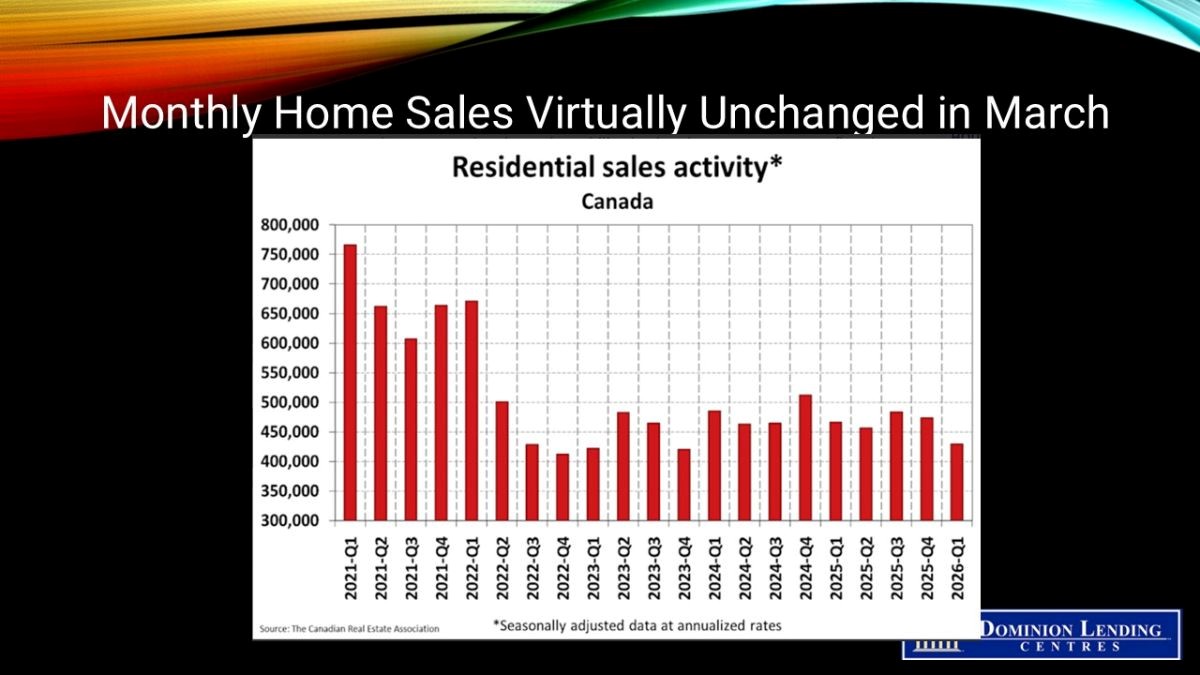
The number of home sales recorded over Canadian MLS® Systems was virtually unchanged (-0.1%) on a month-over-month basis in March 2026.
“Home sales activity remained at lower levels in March, as rising global economic uncertainty, along with a mid-month jump in fixed mortgage rates tied to incoming higher inflation, piled on to an already shaky economic start to the year,” said Shaun Cathcart, CREA’s Senior Economist. “2026 is still expected to see a modest amount of upward momentum in sales and a stabilization in prices as some pent-up first-time buyer demand enters the market, but the forecast for the year has had to be revised downward. The timing of higher mortgage rates, along with the perception they may be temporary, could keep would-be buyers away at the most active time of year – April, May, and June – as they wait for rates to come back down.”
Clearly, the War in Iran, along with its unprecedented oil price shock, has spooked households and businesses, weakening overall economic activity, especially housing, which is highly interest-rate sensitive. Interest rates have risen sharply since the war began in late February, and it is uncertain how long higher oil prices will last. The reopening of the Strait of Hormuz is highly tentative, and it will take weeks, if not months, to return oil prices to pre-war levels.
The war’s timing couldn’t be worse, as it damages the usually strong spring home-selling season.
New Listings
New listings edged down a slight 0.2% on a month-over-month basis in March 2026. Lower monthly sales numbers so far in 2026 could in part be due to the fact new supply is running at the lowest levels since mid-2024.
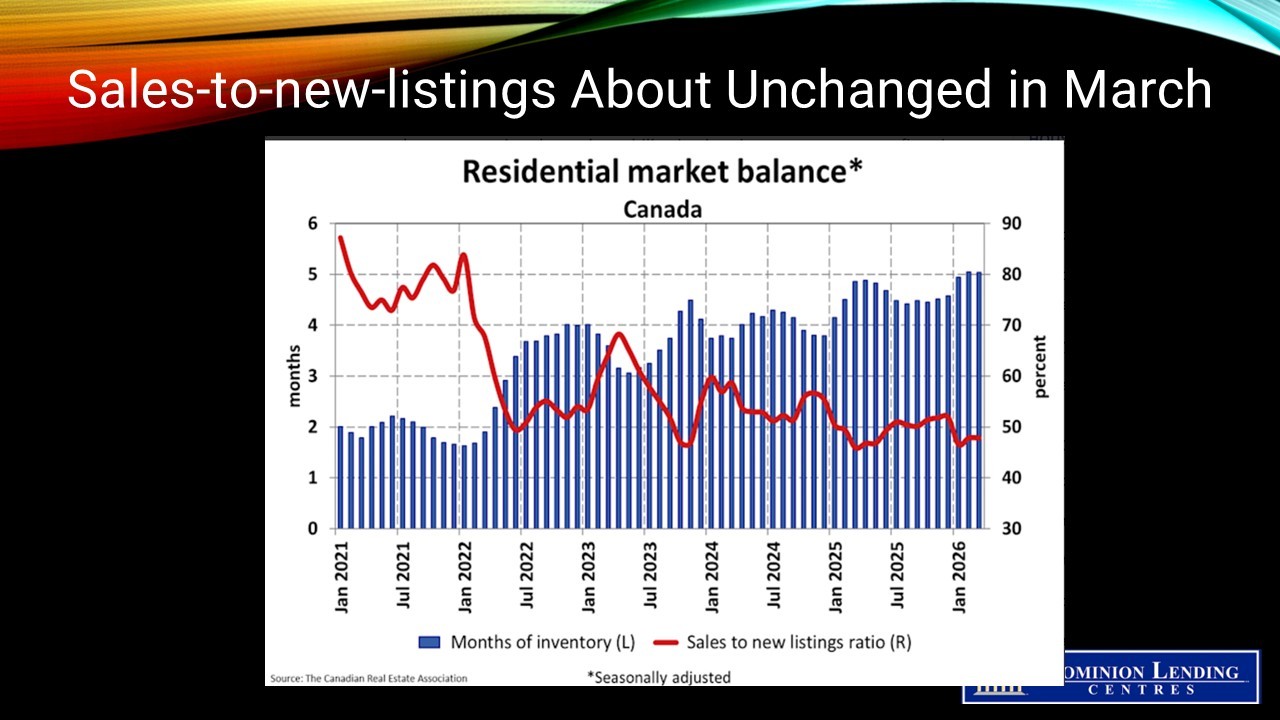
With new supply and sales both little changed in March, the national sales-to-new listings ratio remained at 47.8%. The long-term average for the national sales-to-new listings ratio is 54.8%, with readings generally between 45% and 65% that are consistent with balanced housing market conditions.
“While the interest rate situation has recently changed, what could be a challenge for a buyer looking for a fixed rate mortgage may also be seen as more choice and less competition for those choosing a variable rate,” said Garry Bhaura, CREA’s 2026-2027 Chair. “Spring tends to be a busier time of year for the housing market, even if it may not be quite as busy as we were expecting not so long ago.”
There were 167,524 properties listed for sale on all Canadian MLS® Systems at the end of March 2026, up just 1% from a year earlier and 10.6% below the long-term average for that time of the year. Overall supply has generally been declining since May of last year.
There were five months of inventory on a national basis at the end of March 2026, unchanged from January and February and right in line with the long-term average for the measure. Based on one standard deviation above and below that long-term average, a seller’s market would be below 3.6 months, and a buyer’s market would be above 6.4 months.
Home Prices
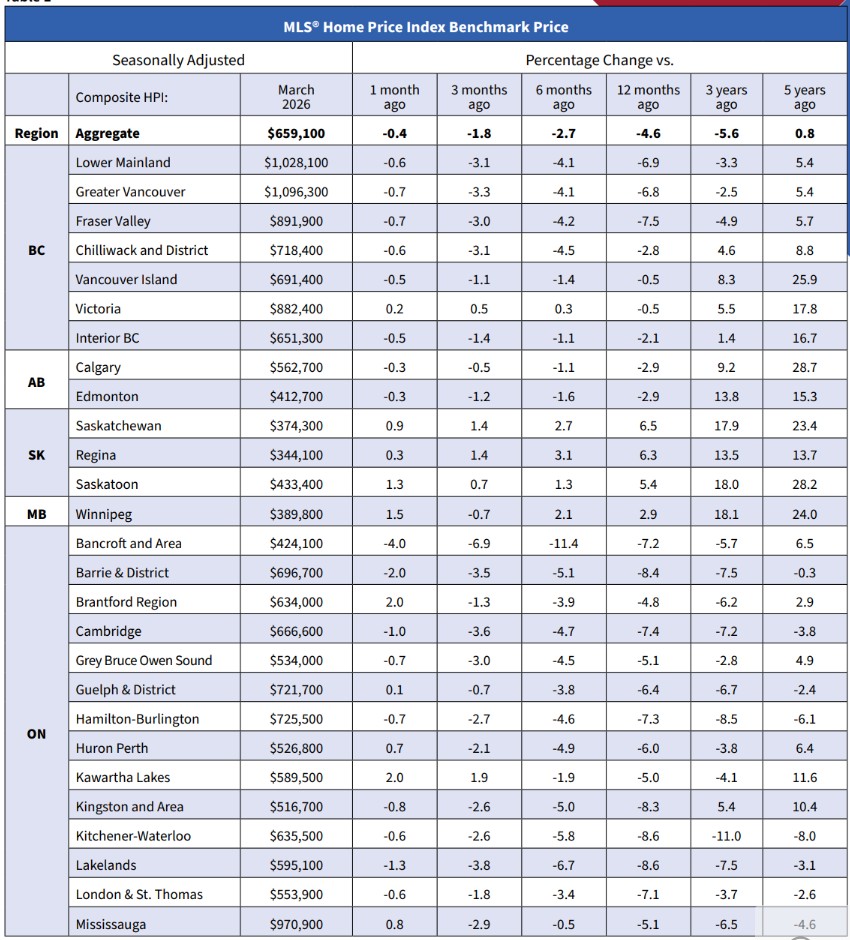
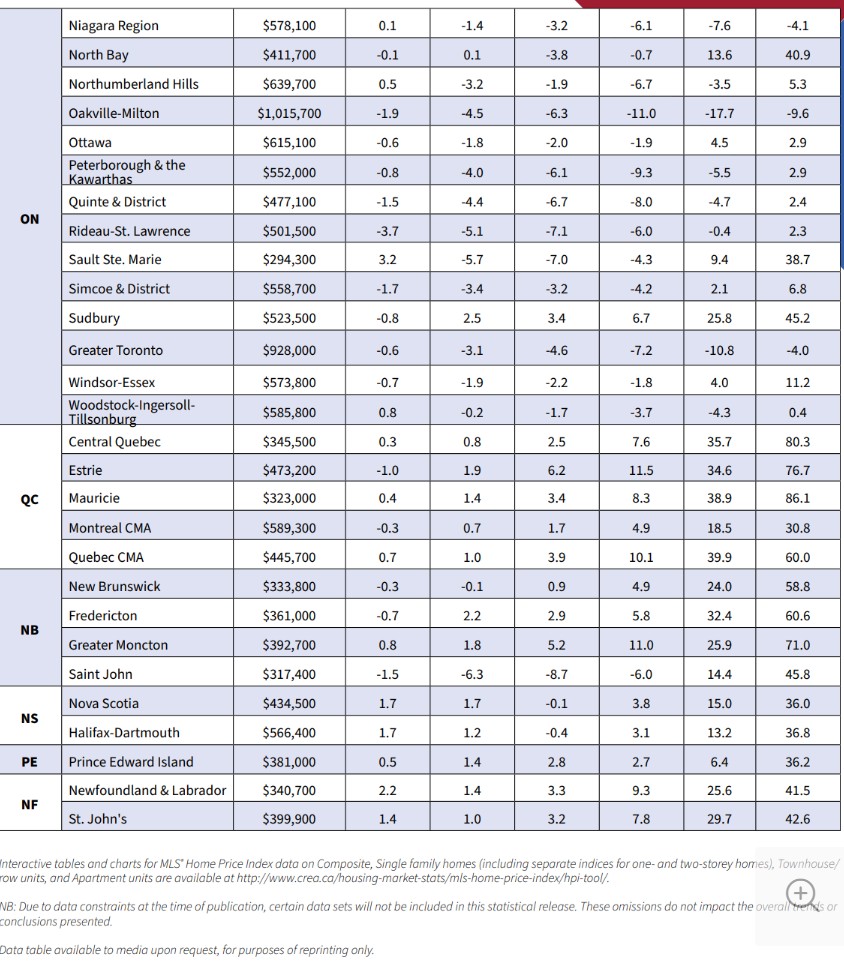
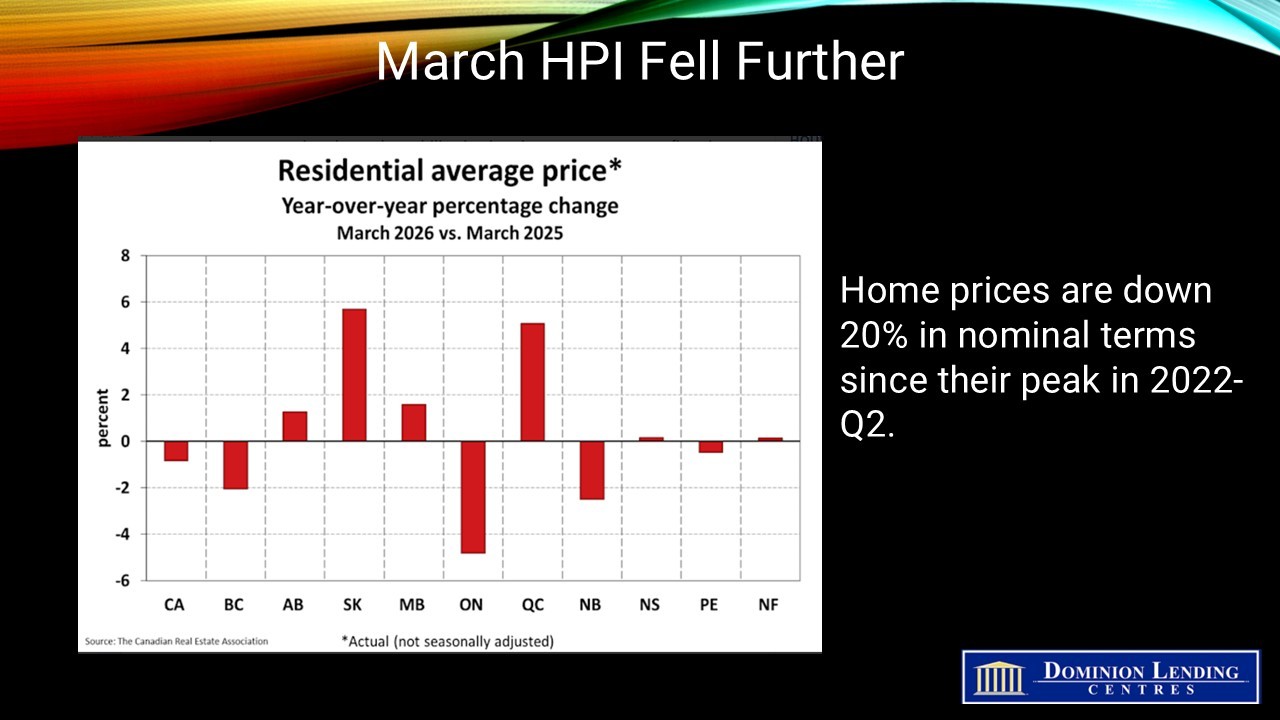
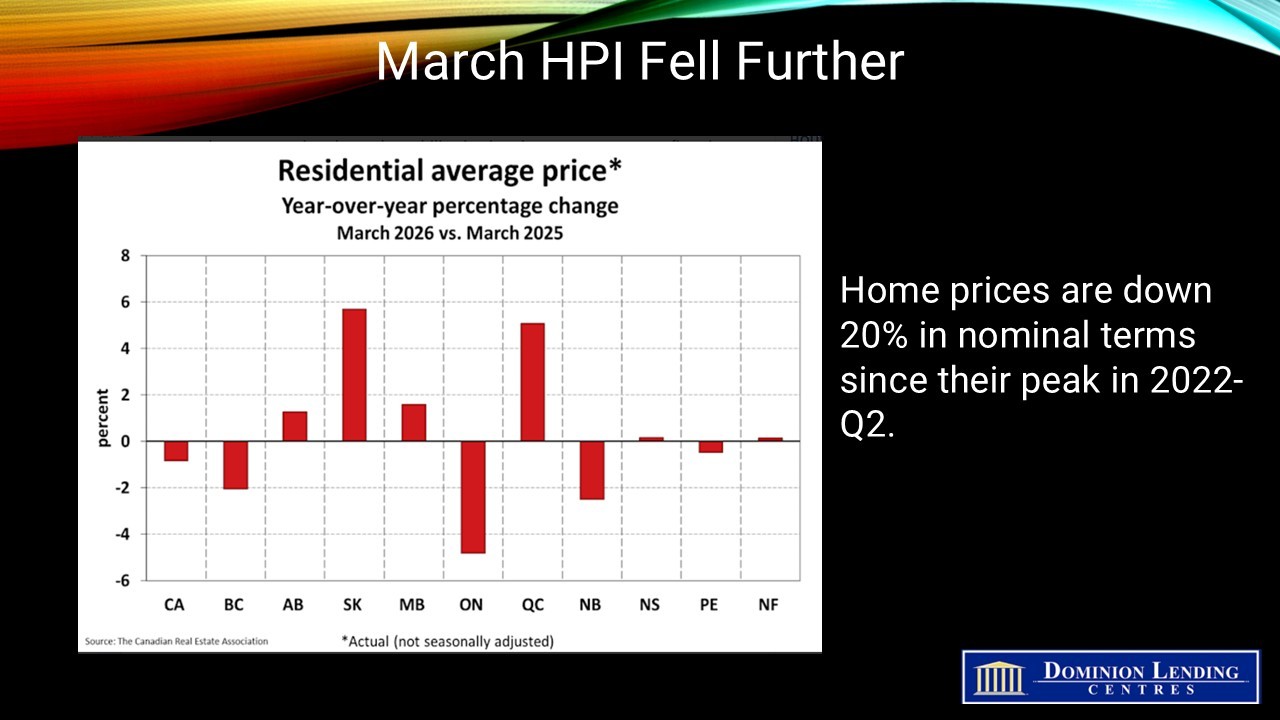
The National Composite MLS® Home Price Index (HPI) edged down 0.6% on a month-over-month basis in February, not a small decline but smaller than in January.
The non-seasonally adjusted National Composite MLS® HPI was down 4.8% compared to February 2025.
Bottom Line
With geopolitical tensions mounting and the tenuous ceasefire in Iran, potential homebuyers have postponed their purchase decisions. While there remains considerable pent-up demand, and home prices in many regions have fallen sharply, especially in Ontario, which was hardest hit by the tariffs last year and the ongoing condo supply glut. These issues are unlikely to be resolved in the near term so that housing market weakness will remain a drag on overall economic activity.
Compounding these concerns is the surge in oil prices. Gasoline prices–a very visible component of consumer spending–have skyrocketed, causing supply disruptions in nitrogen fertilizer, plastics, aluminum and helium. Price pressures will no doubt mount, leading central banks to be concerned about potential stagflation. Next Monday, we will see the CPI data for March. At this point, the Bank of Canada is likely to continue to “look through” the price pressures, hoping the war will end very soon.