Bank of Canada Holds The Overnight Policy Rate Steady For the Fourth Consecutive Meeting.
Bank of Canada Holds Policy Rate Steady
Today, the Bank of Canada once again held the policy rate steady at 2.25%. This is the bottom of the Bank’s estimate of the neutral overnight rate, where monetary policy is neither expansionary nor contractionary. With inflation hovering at 2.4% and core inflation falling to 2.0%, the Governing Council sees the current overnight rate as appropriate, as the Bank looks through the inflationary effects of the war in Iran.
“The evolving conflict in the Middle East is causing heightened volatility, and US trade policy continues to reshape global trade patterns. Both are ongoing sources of uncertainty. The Bank’s April outlook assumes tariffs remain unchanged and the global benchmark price of oil declines to US$75 per barrel by mid 2027, still well above pre-war oil prices”. According to the BoC, if that happens, inflation should peak around 3% in April and ease back to the 2% target by early next year.
“The Iran war has led to sharply higher energy prices and transportation disruptions, diminishing growth prospects in oil-importing countries and boosting inflation worldwide. In the United States, growth is still expected to be solid over the projection horizon, boosted by AI-related investment and consumption growth. China’s economy is supported by robust exports. In the euro area, higher prices for oil and natural gas will weigh on economic activity.”
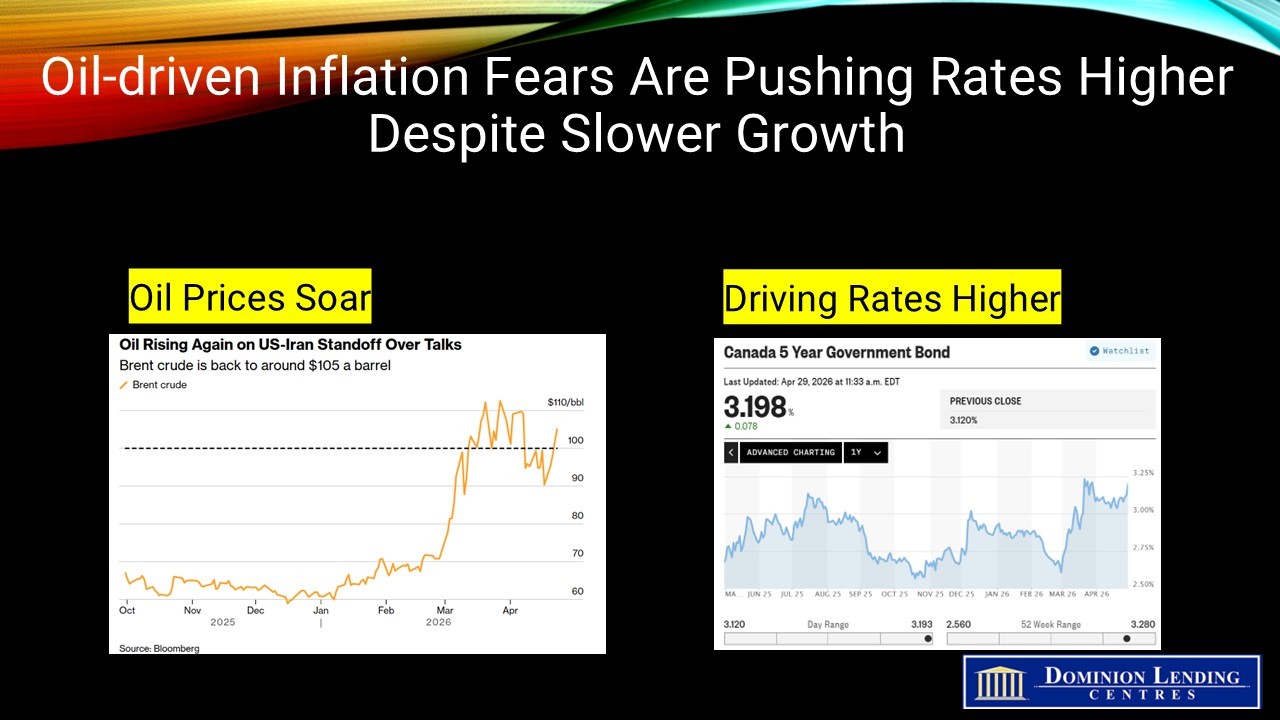
Bond yields are modestly higher since January, while equity markets, which weakened sharply at the outset of the war, have recovered. Since the start of the war, the US dollar has appreciated against most major currencies.
“The outlook for economic growth in Canada is little changed from the January Monetary Policy Report (MPR) projection. After a contraction in the fourth quarter of 2025, growth is forecast to have resumed in early 2026. Consumer and government spending are supporting economic activity, while tariffs and trade uncertainty are weighing on exports and business investment. Housing activity declined in the fourth quarter and is held back by slow population growth, economic uncertainty and ongoing affordability issues. The labour market is soft, with subdued employment growth over the past year and job losses in sectors targeted by US tariffs. The unemployment rate remains in the 6½%‑7% range, reflecting both weak hiring and fewer job seekers.”
The Bank’s April forecast projects GDP growth of 1.2% in 2026, rising to 1.6% in 2027 and 1.7% in 2028 as growth in exports and business investment resumes along a lower trajectory. With GDP growing slightly above potential, the current excess supply in the economy is gradually absorbed. While the war in Iran may alter its composition, overall GDP growth is little changed in the updated forecast: Since Canada is a large net exporter of oil, higher oil prices increase national income even as consumers are squeezed by higher gasoline prices.
The Bank’s press release goes on to say that “CPI inflation will likely rise further in April to about 3%. Based on the assumption that oil prices will ease, inflation is forecast to come down to the 2% target early next year and remain around 2% over the projection horizon.
Against this backdrop and taking into account the current projection, Governing Council decided to maintain the policy rate at 2.25%. We are closely monitoring the impact of the conflict in the Middle East and the economy’s response to US tariffs and trade policy uncertainty. Governing Council is looking through the war’s immediate impact on inflation, but will not let higher energy prices become persistent inflation. As the outlook evolves, we stand ready to respond as needed. The Bank is committed to maintaining Canadians’ confidence in price stability through this period of global upheaval.”
WTI crude oil futures jumped more than 5% to above $105 per barrel on Wednesday, amid no signs of a near-term end to the conflict with Iran or the reopening of the Strait of Hormuz. The surge comes as markets weigh the United Arab Emirates’ shock exit from OPEC alongside signs that the conflict involving Iran may persist. Reports that Donald Trump is preparing to extend a blockade on Iranian ports have heightened fears of prolonged supply disruptions, particularly through the critical Strait of Hormuz. Negotiations remain stalled, with both sides entrenched, raising expectations that the standoff could drag on for weeks. Meanwhile, US inventory data showed sharp declines in crude and fuel stockpiles, while exports surged to record highs above 6 million barrels per day, underscoring tightening global supply. Gasoline and refined fuel prices have also spiked, amplifying inflation concerns worldwide as energy markets remain on edge.
The Canadian dollar weakened, and market-driven interest rates rose despite the Bank of Canada’s rate hold. The Fed is expected to follow suit this afternoon, maintaining its policy rate at 3.5% to 3.75%.
Bottom Line
The Bank of Canada has shown its willingness to bolster the Canadian economy amid unprecedented trade uncertainty and a record oil price shock. Ottawa, too, has taken actions to reduce the burden of higher prices on Canadians by temporarily eliminating the excise tax on oil. PM Carney is also working to diversify Canadian trade away from the US.
There will continue to be substantial frictions that limit the geographical diversification of trade sought by Ottawa. The US is Canada’s only neighbour; hence, there is a lack of alternative markets that equal the US in size and scale, and, before Trump, in shared values on free trade.
In his speech before the press conference today, Governor Tiff Macklem suggested that, “if the United States were to impose significant new trade restrictions on Canada, we may need to cut the policy rate further to support economic growth. Alternatively, if oil prices continue to increase, and particularly if they remain elevated, the risk that higher energy prices become ongoing generalized inflation increases. If this starts to happen, monetary policy will have more work to do—there may be a need for consecutive increases in the policy rate.
It is highly unlikely that the Bank of Canada would tighten monetary policy when the housing market is as depressed as it is today.