Weakest Labour Market Report Since January 2021.
Weak Jobs Report in April drives Unemployment Rate Up to 6.9%
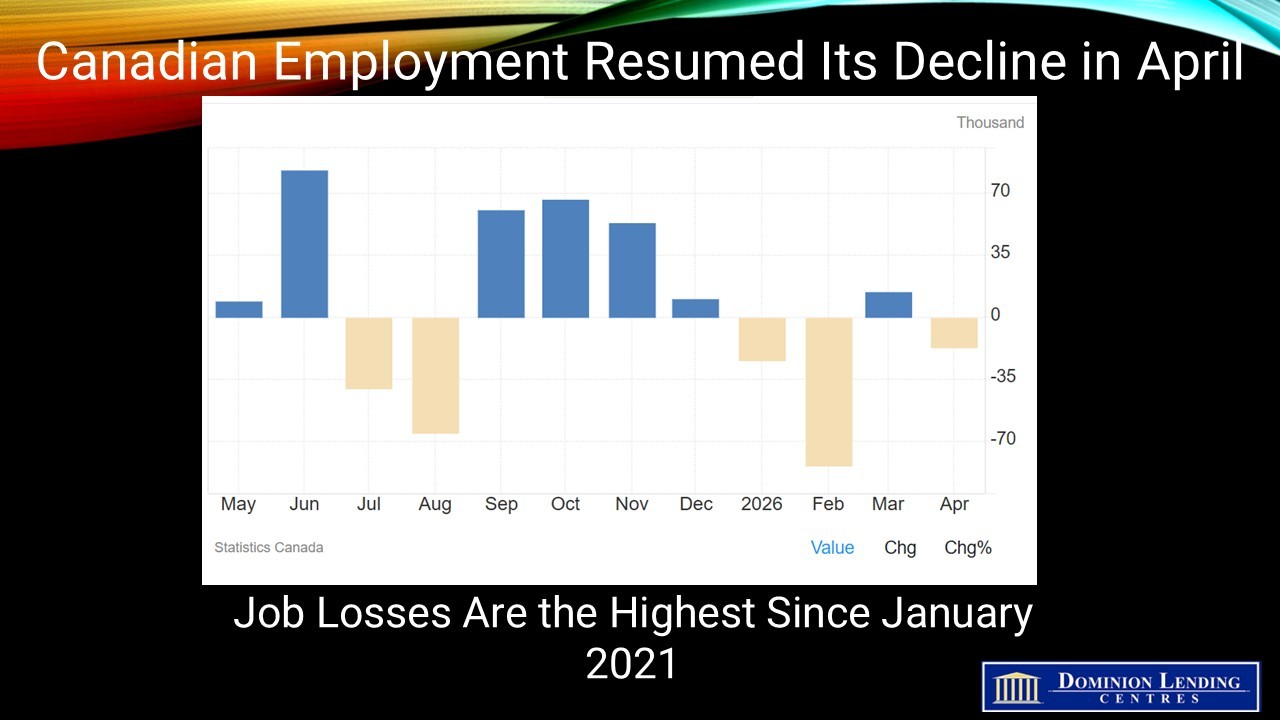
Employment in Canada edged down by 17,700 in April, following a 14,000 gain in the prior month, missing the consensus forecast for a 15,000 increase. On a year-over-year basis, employment in April was up by 67,000 (+0.3%), but recorded a net decline of 112,000 (-0.5%) over the first four months of 2026.
The result marked a second straight month of limited movement after February’s sharp 84,000-job decline. Full-time employment fell by 47,000, while part-time positions increased by 29,000. Employment levels were broadly unchanged across the private and public sectors and among self-employed workers.
Employment varied little across major age groups in April. The unemployment rate rose among youth aged 15 to 24 to 14.3% and among core-aged men to 6.1%. Regionally, employment declined in Quebec, Newfoundland and Labrador, Saskatchewan, and New Brunswick, while Ontario added 42,000 jobs. Meanwhile, the employment rate slipped 0.1 percentage points to 60.5%.
Average hourly wages among employees were up 4.5% (+$1.64 to $37.77) on a year-over-year basis in April, following growth of 4.7% in March (not seasonally adjusted).
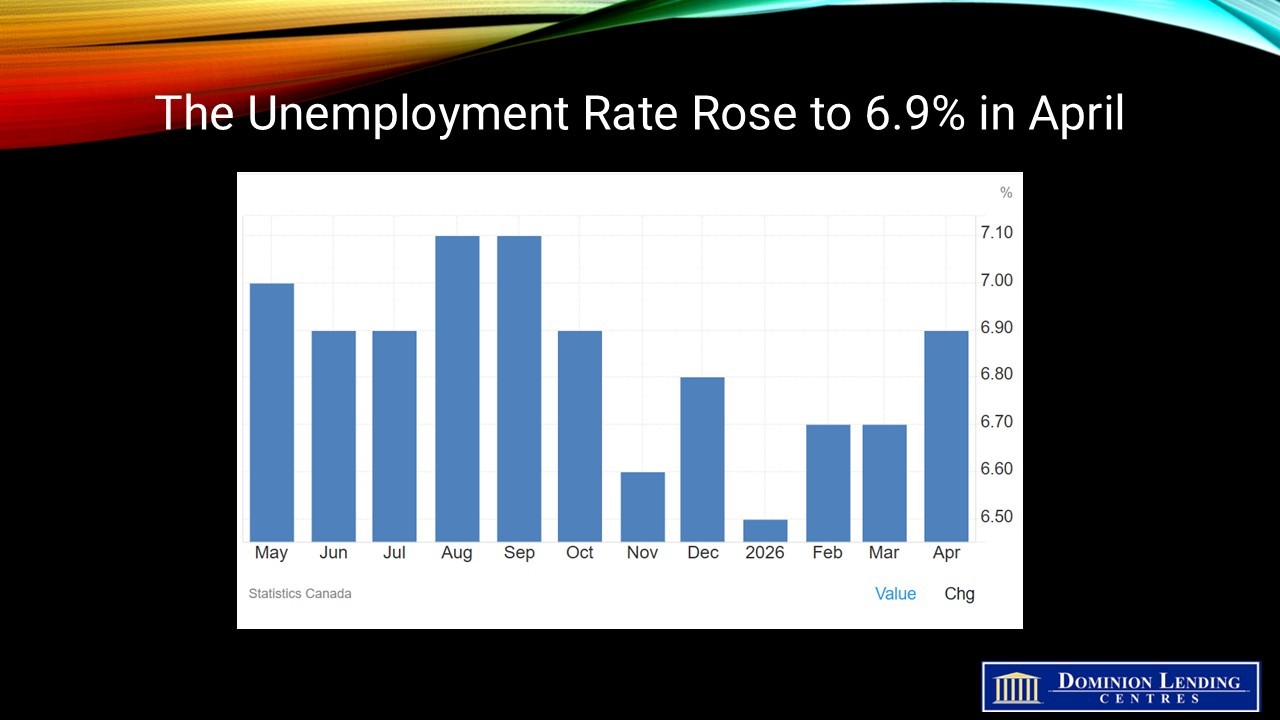
In April, the unemployment rate rose 0.2 percentage points to 6.9%, as more people searched for work (+51,000; +3.4%). The unemployment rate has increased 0.4 percentage points since January 2026, but remained below the recent peak of 7.1% observed in August and September of 2025. On a year-over-year basis, the unemployment rate was virtually unchanged in April 2026.
The proportion of unemployed people who had been continuously searching for work for 27 weeks or more—considered long-term unemployment—was 22.5% in April. This proportion was little changed both in the month and compared with 12 months earlier. However, it remained significantly above the pre-COVID-19 pandemic average of 17.1% observed from 2017 to 2019.
At the same time, the monthly layoff rate (0.6%) in April remained in line with the pre-pandemic average, showing no recent elevation (not seasonally adjusted).
The participation rate—the proportion of the population aged 15 and older who were employed or looking for work—rose by 0.1 percentage points to 65.0% in April as more people were in the labour force searching for work. The increase was concentrated among core-aged people, whose labour force participation rate rose 0.3 percentage points to 88.5%.
On a year-over-year basis, the overall labour force participation rate was down 0.3 percentage points in April. This largely reflected population aging, which has put downward pressure on the labour supply as more individuals have entered retirement. Among core-aged people, the labour force participation rate was up 0.3 percentage points year over year, while for youth aged 15 to 24, it was little changed.
On a month-over-month basis, employment decreases in April were concentrated in information, culture and recreation (-25,000; -2.8%), construction (-16,000; -1.0%), and in ‘other services’ (-13,000; -1.6%), an industry which includes repair and maintenance as well as personal services.
Employment change by industry, April 2026
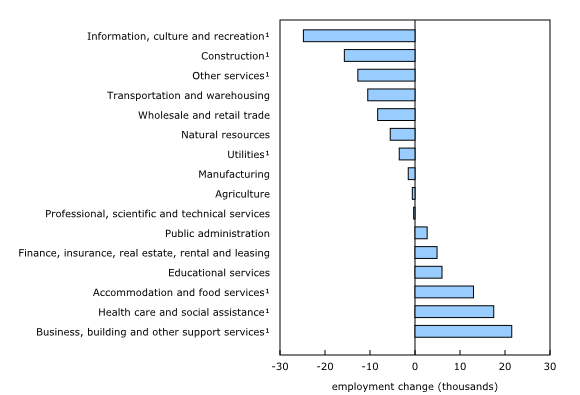
On the other hand, employment increased in business, building and other support services (+22,000; +3.2%), health care and social assistance (+18,000; +0.6%) and in accommodation and food services (+13,000; +1.1%).
On a year-over-year basis, employment was little changed across most industries in April, with the notable exception of health care and social assistance, which was up 119,000 (+4.1%) over the period.
The cumulative decline in employment since January comes as US tariffs continue to loom over businesses and the war in Iran heightens global uncertainty, two forces expected to shape the Canadian economy this year. With the 50% rise in oil prices, demand destruction is already well underway.
Another important fundamental in the labour market is the rapid development of AI, which is already causing enormous layoffs, especially in the U.S. See the chart below.

Bottom Line
In other news, the US employment report was also released this morning, showing the strongest two-month gain since 2024.
US employers added more jobs than expected for a second month, and the unemployment rate held steady in April, indicating the labour market is holding up despite rising energy costs sparked by the war in Iran.
Nonfarm payrolls rose 115,000 last month after an even bigger surge in March, marking the strongest two-month increase since 2024, according to Bureau of Labour Statistics data out Friday. The unemployment rate was unchanged at 4.3%. The report showcases a labour market that may be gaining momentum after near-zero job growth last year. It showed hiring advanced across a variety of sectors, and follows other data indicating layoff activity remains low.
The relative weakness of the Canadian labour market will discourage the Bank of Canada from tightening monetary policy too soon. To be sure, inflation remains a risk as higher energy costs become embedded in the price of a wide array of goods and services. The Bank will be reluctant to respond with rate hikes over the next few announcement dates.
Trade negotiations will accelerate in the coming months as the future of CUSMA is determined. It is hard to imagine the Bank of Canada tightening in the face of such a weak housing market.