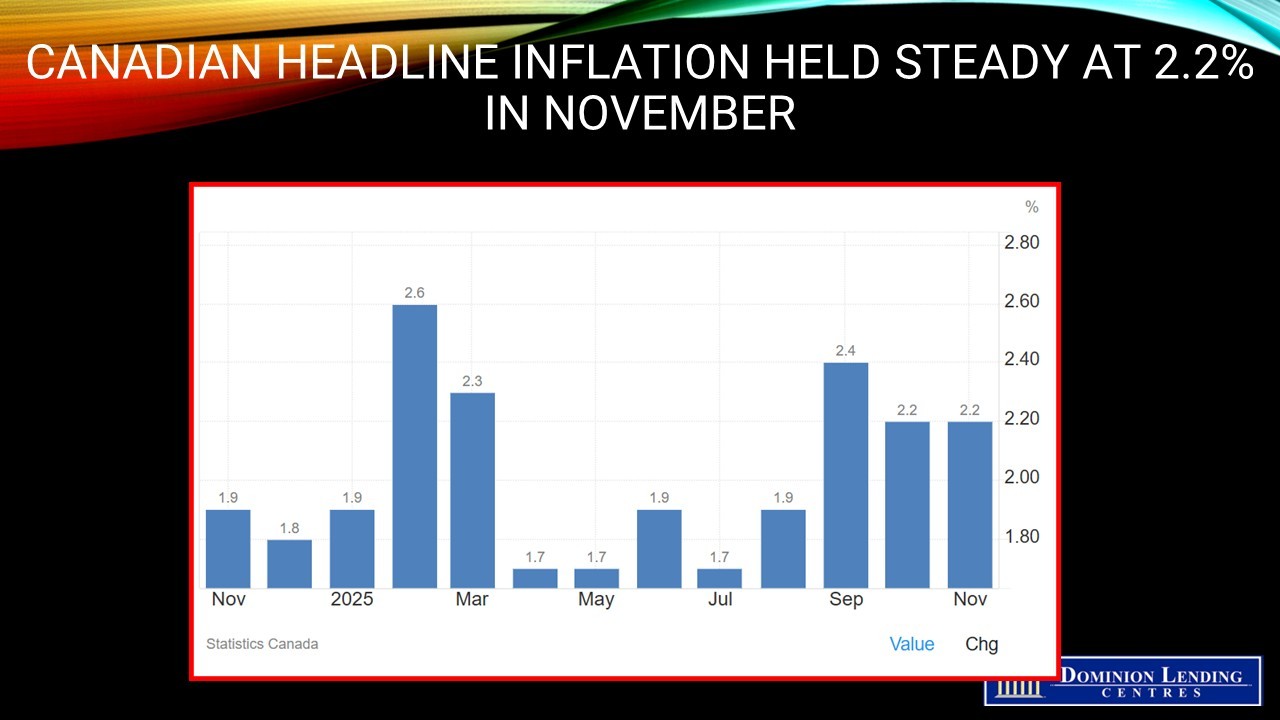
The Consumer Price Index (CPI) rose 2.2% on a year-over-year basis in November, matching the increase in October..
Good News on the Inflation Front Will Keep the BoC on the Sidelines
The Consumer Price Index (CPI) held steady at 2.2% year over year in November, as core inflation continued to ease. Accelerating costs for food and some other goods were offset by slowing price growth for services.
In November, prices for services rose 2.8% year over year, compared with a 3.2% increase in October. Prices for travel tours declined 8.2% last month following a 2.6% increase in October. Monthly, these prices fell 12.0%, as lower demand for destinations in the United States put downward pressure on the index.
Prices for traveller accommodation fell to a greater extent on a year-over-year basis in November (-6.9%) than in October (-0.6%). The most significant contributor to the lower prices was Ontario (-20.2%), partially due to a base-year effect from a swift monthly increase in November 2024 (+11.0%), which coincided with a series of high-profile concerts in Toronto.
Lower prices for travel tours and traveller accommodation, in addition to slower growth for rent prices, put downward pressure on the all-items CPI.
Offsetting the slower growth in services on an annual basis were higher prices for goods, driven by increases in grocery prices and a smaller decline in gasoline prices. Excluding gasoline, the CPI rose 2.6% for the third consecutive month.
The CPI rose 0.1% month over month in November. On a seasonally adjusted monthly basis, the CPI increased 0.2%.
Grocery Price Inflation Highest Since the end of 2023
Prices for food purchased from stores rose 4.7% year over year in November after increasing 3.4% in October. The increase in November was the largest since December 2023 (+4.7%). The main contributors to the acceleration in November 2025 were fresh fruit (+4.4%), led by higher prices for berries, and other food preparations (+6.6%).
In November, prices for fresh or frozen beef (+17.7%) and coffee (+27.8%) remained significant contributors to overall grocery inflation on an annual basis. Higher beef prices have been driven, in part, by lower cattle inventories in North America. Adverse weather conditions in growing regions have affected coffee prices, which have risen amid American tariffs on coffee-producing countries, contributing to higher prices for refined coffee.
On a monthly basis, grocery prices rose 1.9% in November, the largest month-over-month increase since January 2023.
Acting as a bit of a counterweight, shelter costs—the earlier inflation villain—continue to moderate. Owned accommodation expenses are now up just 1.7% y/y, the slowest pace in almost a decade amid sagging home prices. Rent inflation remains sticky, but did tick down to 4.7% y/y last month. Keep an eye on electricity prices, which have been a major issue in the US, where AI data centers consume large amounts of electricity. The cost of electricity jumped 1.5% in the month and is now up 3.4% y/y. Telephone services have also leapt recently, after falling heavily the past two years; they are now up 11.7% y/y, the fastest increase since 1982.
The good news is that inflation will average just over 2% for all of 2025, down from 2.4% last year and the lowest annual tally in five years. The less-good news is that this moderation was mainly due to the removal of the consumer carbon tax, which alone shaved about half a point off the annual average.
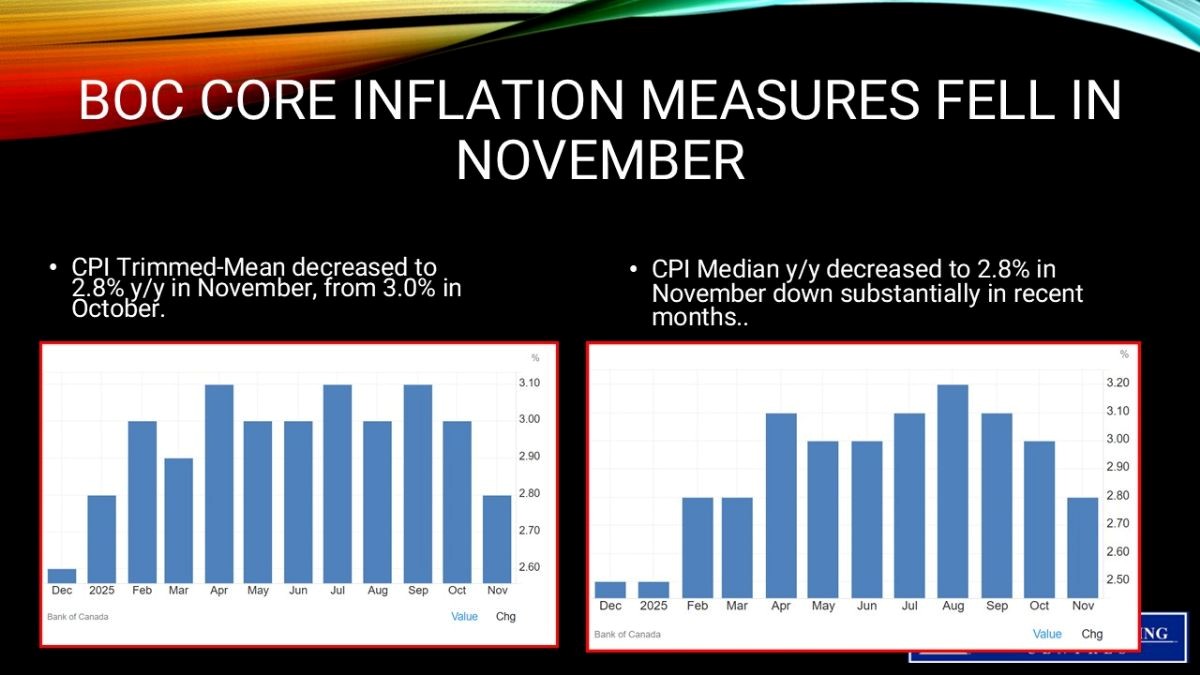
The main core inflation measures decelerated in November, with the BoC’s two measures both easing two ticks to 2.8% y/y (and both up just 0.1% m/m in seasonally adjusted terms). And, ex food & energy prices also rose just 0.1% m/m, cutting the annual rate three ticks to a moderate 2.4% y/y pace.
Bottom Line
This report confirms the Bank’s hold on the policy rate. Aside from food prices, inflation seems to be dissipating. The overall economy is in better-than-expected shape as the upward revisions in GDP since 2022 were largely the result of better than expected productivity growth–long a big concern for the Canadian economy.
The backdrop of better growth and lower inflation will keep the Bank of Canada on hold for most of 2026, as the next move in rates is likely to be a hike, but not until late next year. In the meantime, the biggest loser in the past year has been the housing market.
Today’s release of existing home sales by the Canadian Real Estate Association suggests particularly weak activity in Ontario, the region hardest hit by the tariff uncertainty. A cautious Bank of Canada will monitor the effect of rapidly rising food prices on inflation expectations. With any luck at all, core inflation will continue to decelerate, keeping the Bank on the sidelines for much of next year.
Hopefully, greater clarity on the Canada-Mexico-US agreement will be forthcoming in the New Year. Reduced uncertainty is the key ingredient required for a rebound in housing activity, particularly in the regions of Ontario and Quebec hardest hit by the tariffs.