Housing Beleaguered in Regions Most Impacted by over-building and tariffs..
Canadian Housing Market in a Holding Pattern
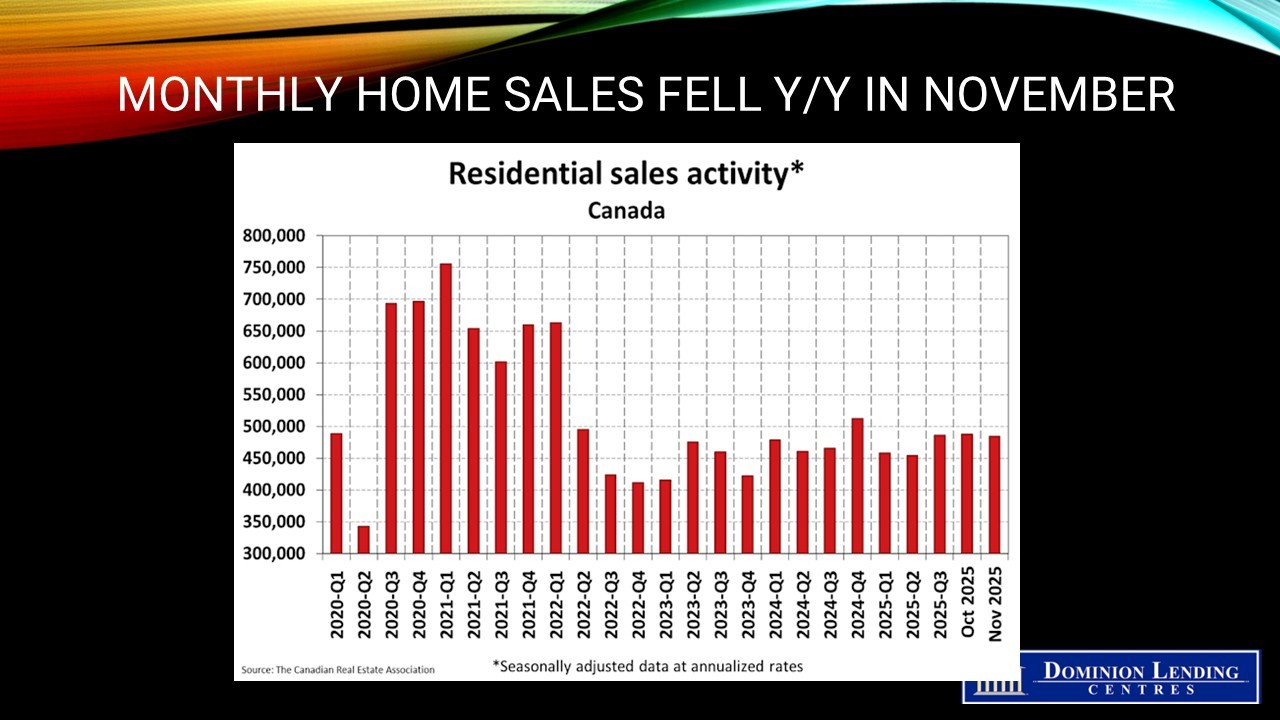
Today’s release of the November housing data by the Canadian Real Estate Association (CREA) showed that national home sales fell year over year, as both month-over-month new listings and the Home Price Index showed prices declined once again.
Over the past month, the consensus for Canada’s economic outlook has shifted. It is now widely believed that the Bank of Canada will remain on the sidelines through most of 2026, and its next move will be a rate hike. In all likelihood, the big move in interest rates is behind us. Moreover, reductions in home prices have dissipated. The hope is that buyers move begin to get serious they see interest rates and home prices bottoming.
The number of home sales recorded on the Canadian MLS® Systems declined 0.6% month over month in November, remaining well above April levels but essentially unchanged since July.
According to Shaun Cathcart, the senior economist of the CREA, “At this point it’s looking like the mid-year rally in housing demand has veered into more of a holding pattern heading into 2026, coupled with what looks like some price concessions in November in order to get deals done before the end of the year. That said, the Bank of Canada’s clear signal that rates are now about as good as they’re likely going to get is the green light many fixed-rate borrowers have no doubt been waiting for, so we remain of the view that activity will continue to pick up next year.” Many are pointing to what they think will be a much more robust spring market.”
New Listings
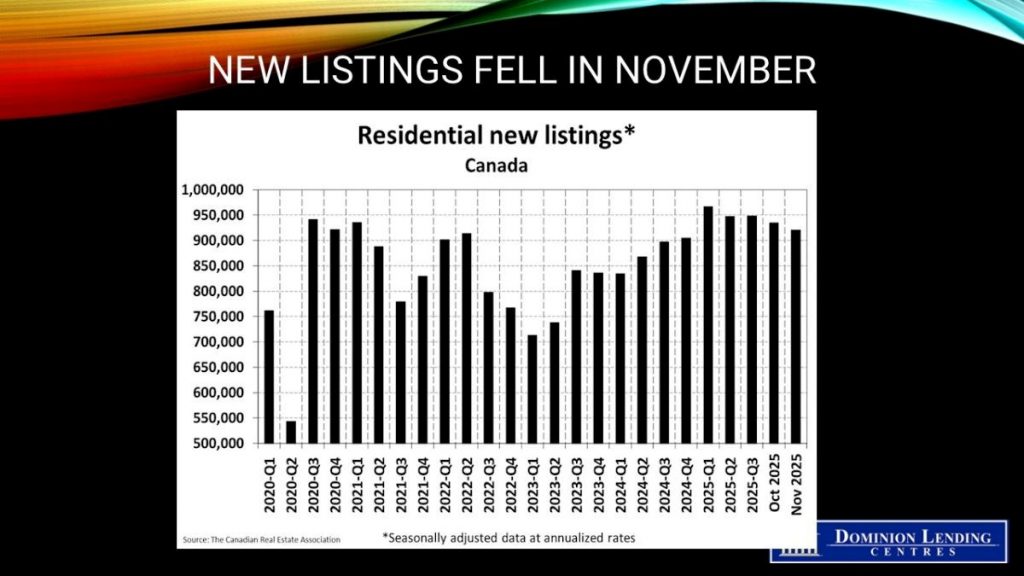
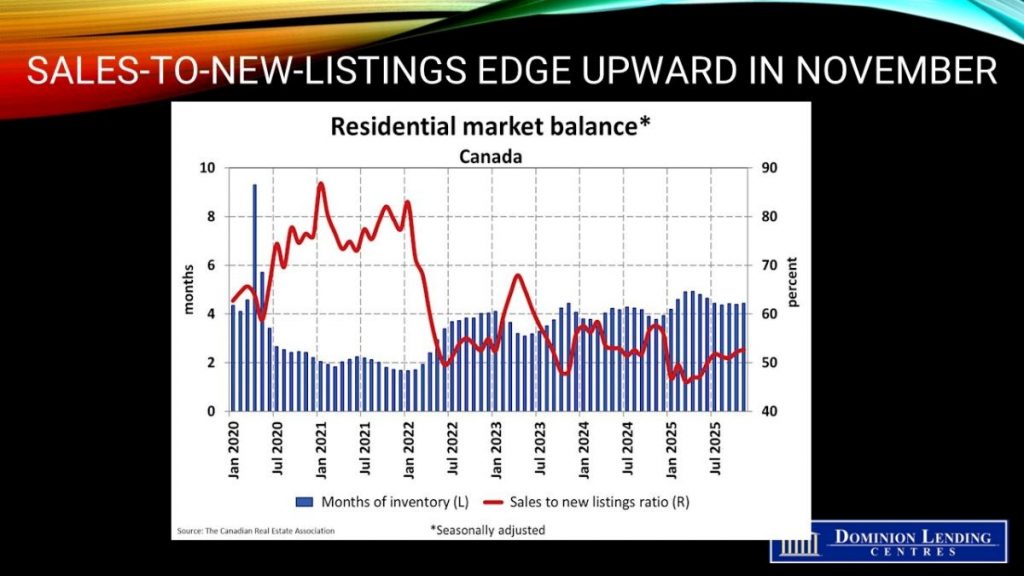
New supply declined 1.6% month over month in November. Combined with a more minor decrease in sales activity, the sales-to-new listings ratio tightened to 52.7% from 52.2% in October. The long-term average for the national sales-to-new listings ratio is 54.9%, with readings roughly between 45% and 65% generally consistent with balanced housing market conditions.
There were 173,000 properties listed for sale across all Canadian MLS® Systems at the end of November 2025, up 8.5% from a year earlier but 2.5% below the long-term average for that time of the year.
“2025 was initially expected to be the year that housing markets came out of their interest rate-induced hibernation, but as we all know, the rug was pulled out from under that recovery by the economic shock of U.S. tariffs,” said Valérie Paquin, CREA Chair. “With interest rates now even lower as a result of a softer economy, the focus shifts to the spring of 2026, and whether we’ll finally see the return of more normal levels of housing activity.
There were 4.4 months of inventory on a national basis at the end of November 2025, basically unchanged from July, August, September, and October. The long-term average for this measure of market balance is five months of inventory.
Based on one standard deviation above and below that long-term average, a seller’s market would be below 3.6 months, and a buyer’s market would be above 6.4 months.
Home Prices
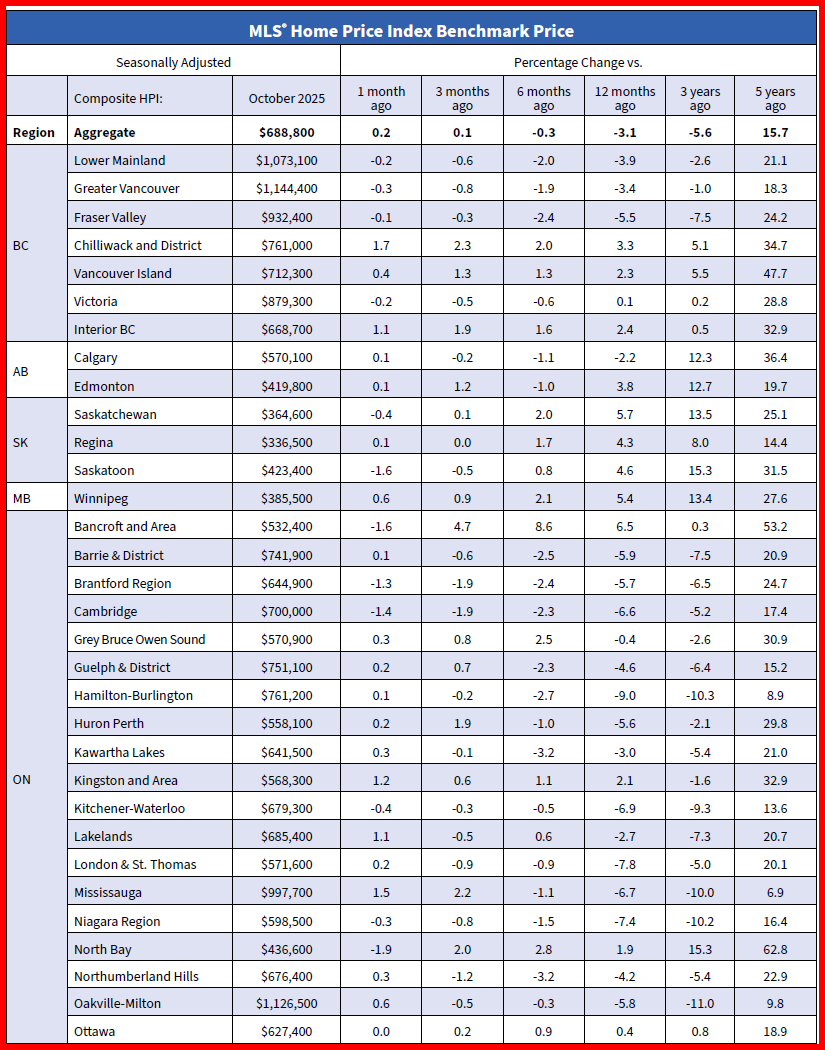
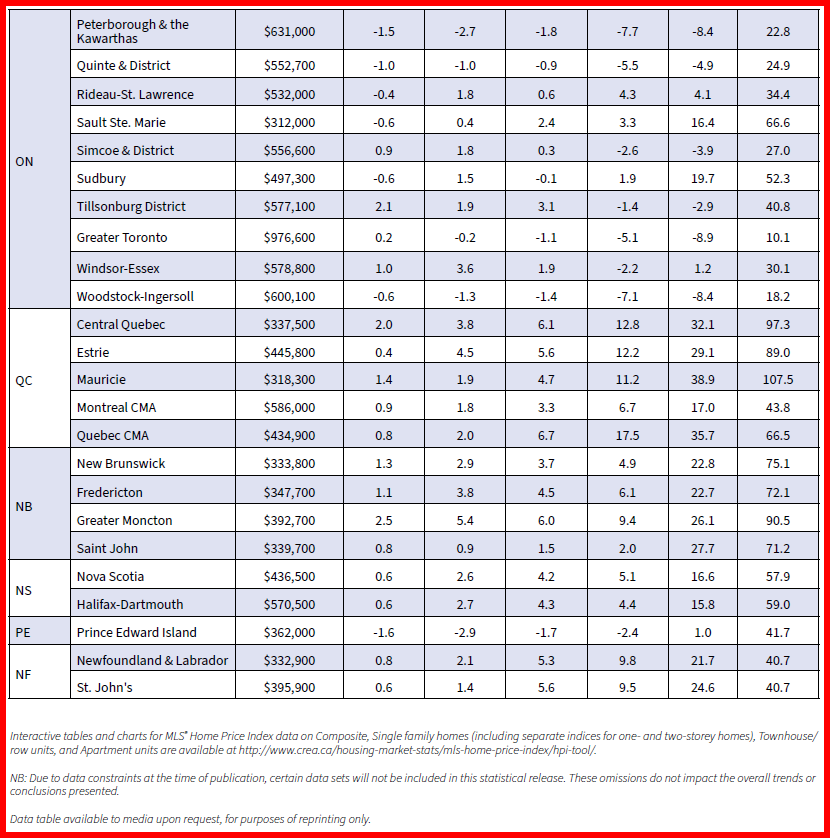
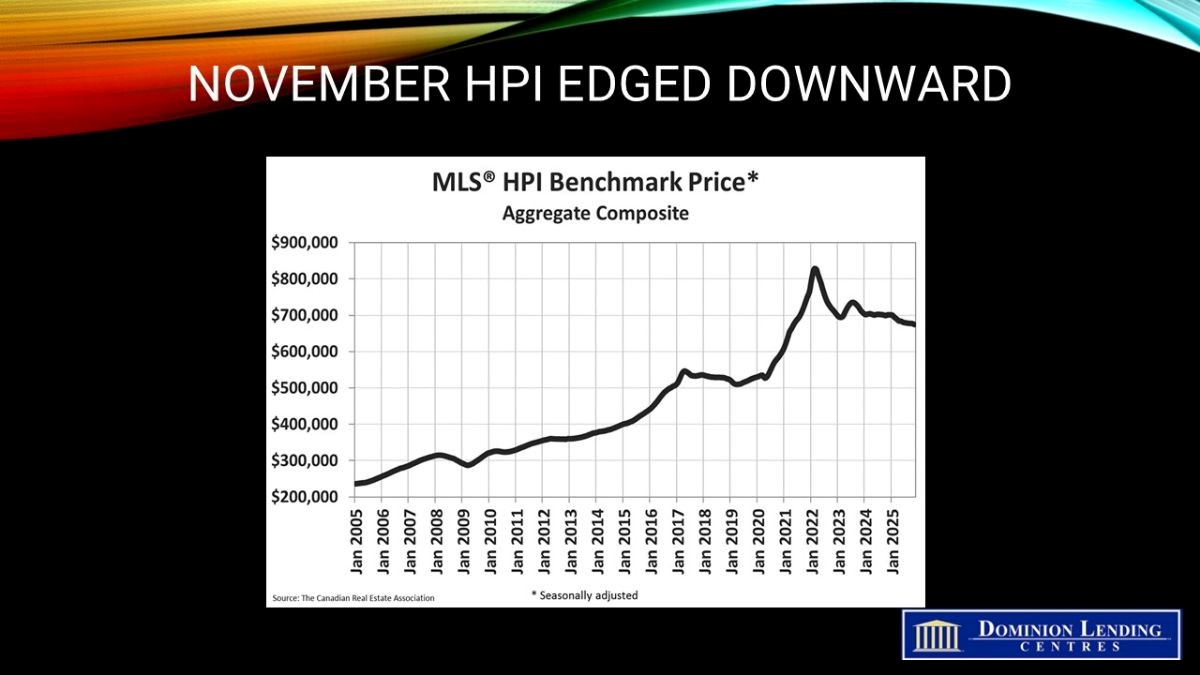
The National Composite MLS® Home Price Index (HPI) edged up 0.2% between September and October 2025. The non-seasonally adjusted National Composite MLS® HPI was down 3% compared to October 2024, the smallest year-over-year decline since March.
The National Composite MLS® Home Price Index (HPI) fell by 0.4% between October and November, suggesting some sellers are making price concessions to get properties sold before the end of the year. The non-seasonally adjusted National Composite MLS® HPI was down 3.7% compared to November 2024.
Bottom Line
Lower interest rates and home prices bottoming should move homebuyers off the sidelines. While the Greater Golden Horseshoe’s housing activity was dampened by sectoral tariffs, trade uncertainty, and earlier overbuilding, even there, the tides are gradually turning. We can look forward to a more robust housing activity.
Canada’s housing market tends to slow as winter approaches and gradually improve, peaking in May or June. But this year is unlike any other, with tariff uncertainty hanging over the markets. As soon as the CUSMA talks begin, and it appears the US will remain in the trilateral trade accord, homebuyers will emerge from their long dormancy.