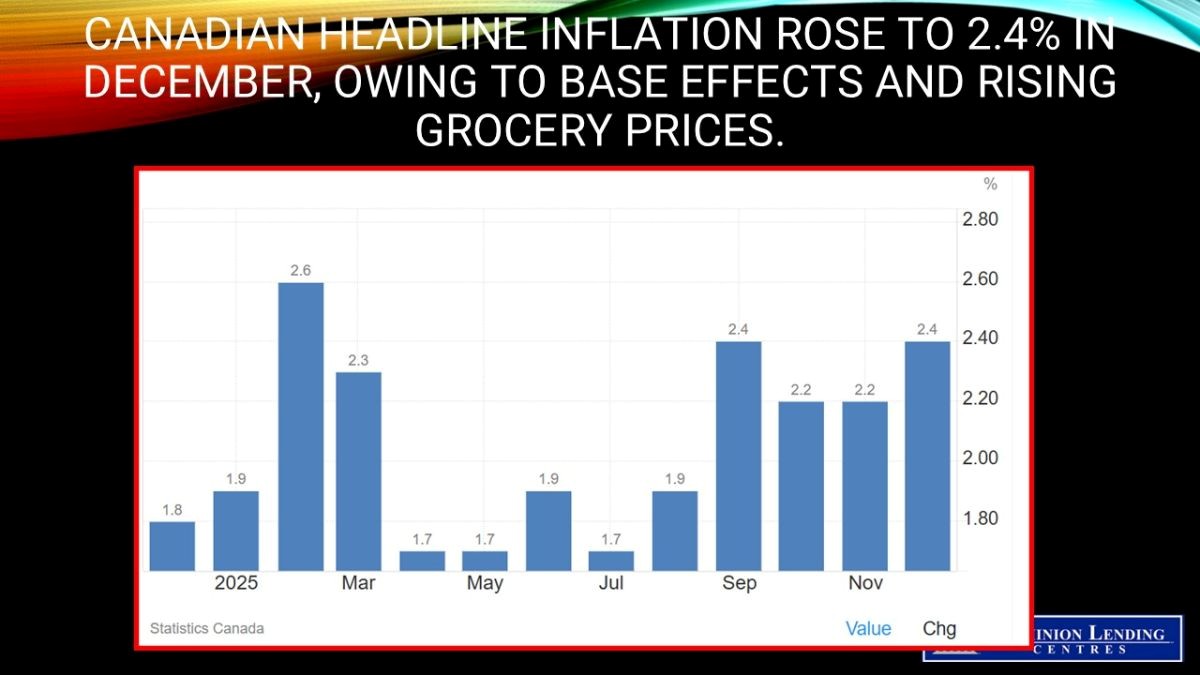
Canadian CPI inflation Jumped to 2.4% y/y in December..
CPI Inflation in Canada Rose to 2.4% in December
The Consumer Price Index (CPI) rose 2.4% on a year-over-year basis in December, following a 2.2% increase in the prior two months.
The year-over-year acceleration in the all-items CPI was driven by the temporary Goods and Services Tax (GST)/Harmonized Sales Tax (HST) break that began on December 14, 2024. This resulted in monthly declines for the exempt goods and services, which have now fallen out of the year-over-year movement, putting upward pressure on headline CPI growth.
The headline CPI accelerated, but the year-over-year decline in gasoline prices in December moderated it. Excluding gasoline, the CPI rose 3.0% in December, following a 2.6% increase in November.
The CPI fell 0.2% month over month in December. On a seasonally adjusted monthly basis, the CPI increased 0.3%.
Various indexes were affected by the GST/HST exemption in December 2024, including restaurant food, alcoholic beverages, toys, games and hobby supplies, children’s clothing and some grocery items, such as potato chips and confectionery.
Year over year, higher restaurant prices were the largest contributor to faster all-items CPI growth in December 2025. Prices for food purchased from restaurants rose 8.5% in December, up from 3.3% in November. Prices for alcoholic beverages served in licensed establishments (+6.5%) and purchased from stores (+5.6%) also rose faster in December.
Prices for toys, games (excluding video games) and hobby supplies rose 7.5% in December, after a 0.5% decline in November. Additionally, prices for children’s clothing accelerated in December (+4.8%) compared with November (+2.4%).
Year-over-year price growth also picked up for potato chips and other snack products (+7.9%) and confectionery (+14.2%).
Despite being unchanged month over month, prices for food purchased from stores rose 5.0% year over year in December. Coffee (+30.8%) and fresh or frozen beef (+16.8%) remained the largest contributors to the increase.
The main core inflation measures decelerated sharply in December, with the BoC’s two measures both easing to their lowest level in a year.

Bottom Line
This report confirms the Bank’s hold on the policy rate. Aside from food prices, inflation seems to be dissipating. The overall economy is in better-than-expected shape, as upward revisions to GDP since 2022 have been largely driven by stronger-than-expected productivity growth, a long-standing concern for the Canadian economy.
The backdrop of stronger growth and lower inflation will keep the Bank of Canada on hold for most of 2026, as the next rate move is likely to be a hike, but not until 2027 unless the US withdraws from CUSMA. In the meantime, the biggest loser in the past year has been the housing market.
Today’s release of existing home sales by the Canadian Real Estate Association suggests particularly weak activity in Ontario, the region hardest hit by the tariff uncertainty. A cautious Bank of Canada will monitor the effect of rapidly rising food prices on inflation expectations. With any luck at all, core inflation will continue to decelerate, keeping the Bank on the sidelines for much of this year.
Hopefully, greater clarity on the Canada-Mexico-US agreement will be forthcoming. Reduced uncertainty is the key ingredient required for a rebound in housing activity, particularly in the regions of Ontario and Quebec hardest hit by the tariffs.