Q1 GDP Growth revised upward from -0.1% to 0.3%, while Q2 came in at 3.3% owing to strong exports and business investment..
Canada’s Economy Grows by 3.3% in Q2 as Q1 Was Revised Into Positive Territory
Statistics Canada reported this morning that the Canadian economy grew at a whopping 3.3% pace in the second quarter, following an upwardly revised 0.3% in Q1 led by upward revisions to exports, particularly non-metallic minerals and energy products. This wipes out the two quarters of negative growth that triggered recession fears. Indeed, a sharp rise in exports, household spending and business investment led Q2 growth, both the result of efforts to broaden our trading relationships beyond the US. Exports surged as our trade balance turned positive for the past four months. Canada’s exports of oil to China and Korea are one example of our success in boosting trade. Businesses are increasingly investing in AI-related capital expenditures.
On a per capita basis, real GDP increased 1.0% in the second quarter of 2026, as the Canadian population declined for the third consecutive quarter.
Exports rose 3.6% in the second quarter of 2026, the largest increase since the first quarter of 2023. The rise in exports in the second quarter of 2026 was led by an increase in exports of passenger cars and light trucks (+27.0%), coinciding with a rebound in auto production in Canada following declines in the preceding two quarters. Higher exports of intermediate metal products, energy products, and industrial machinery and equipment also boosted overall export volumes in the second quarter.
Imports rose 0.3% in the second quarter of 2026, after increasing 3.1% the previous quarter. Higher imports of tires, motor vehicle engines and vehicle parts led the overall increase, followed by imports of basic chemicals and computers and computer peripherals. These increases were partially offset by a decline in imports of intermediate metal products, mainly unwrought gold.
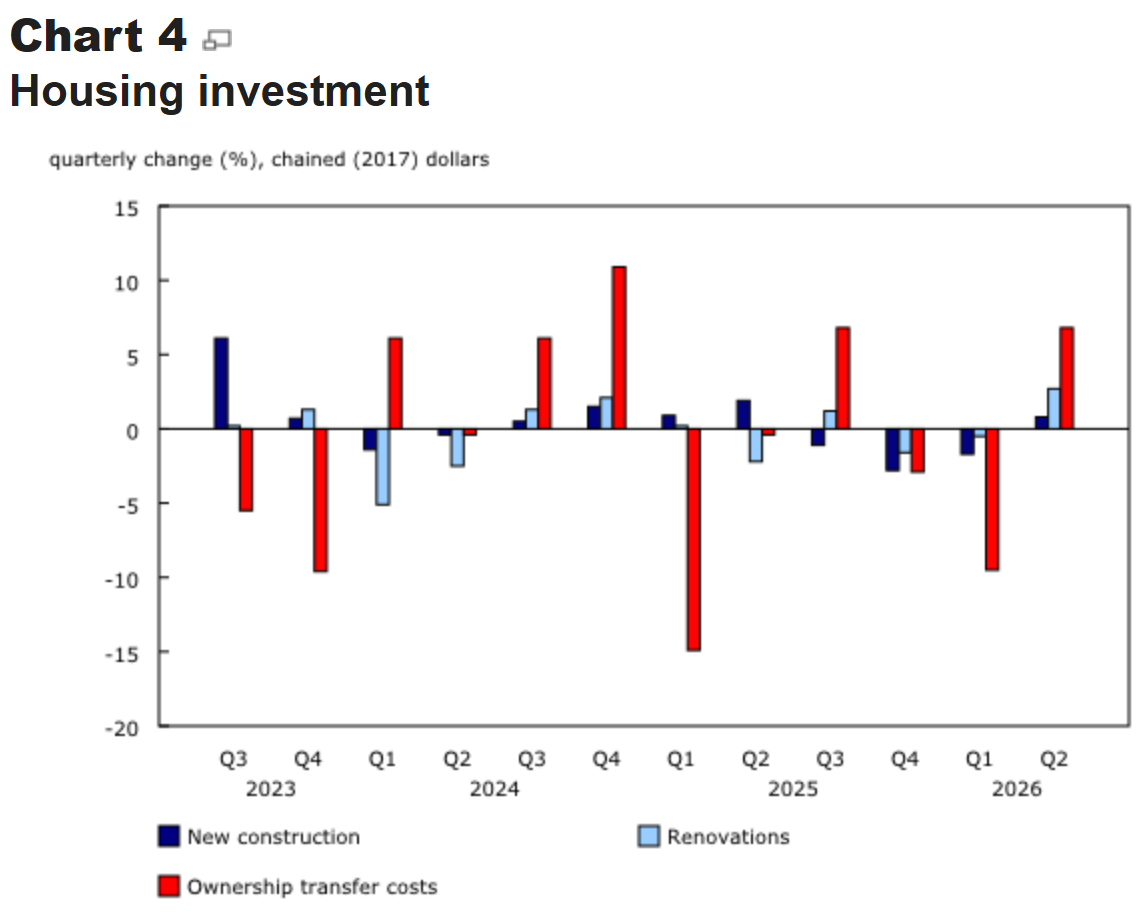
Residential investment rallied in the second quarter of 2026, increasing 2.5% following two consecutive quarterly declines. All components of residential investment were up in the second quarter, with ownership transfer costs—which represents resale activity—rising the most in Ontario, Quebec and British Columbia. New construction rose 0.8% in the second quarter led by work put in place for apartments in British Columbia.
Business investment up on higher machinery and equipment as well as engineering structures
Business capital investment was up in the second quarter of 2026 as engineering structures rose 2.3%, following two consecutive quarters of declines. Business investment was also bolstered by higher spending on machinery and equipment, which rose in the second quarter to its highest level since the second quarter of 2024. Investment in computers and computer peripherals rose 16.7% in the second quarter of 2026, mainly on higher imports of processing units, notably the types used in data centres. Businesses also invested more in medium and heavy trucks as well as communication and audio and video equipment.
Household spending up on higher demand for services
Household final consumption expenditure rose 0.8% in the second quarter of 2026, led by higher spending on mutual funds and other investment services, passenger vehicles and rent. Meanwhile, households purchased less gasoline and food in the second quarter, likely in response to higher prices. On a per capita basis, housing spending was up 1.0% in the second quarter.
Gross domestic product deflator records its largest increases in four years on higher export prices
The GDP deflator rose 2.5% in the second quarter of 2026, the largest increase since the second quarter of 2022. Growth in the deflator was led by export prices, which rose 6.5% in the second quarter of 2026 following a substantial rise in international oil prices. Meanwhile, import prices were up 3.2%, resulting in the terms of trade—the difference between the price of exported goods and services and the price of imported goods and services—increasing 3.3%.
Compensation of employees rises
Compensation of employees increased 1.5% in the second quarter of 2026, led by higher wages in finance, real estate and company management and trade. Wages fell in transportation and storage as well as information and cultural industries.
Compensation of employees grew in all provinces and territories in the second quarter of 2026, ranging from 2.5% in New Brunswick to 0.5% in Newfoundland and Labrador.
Corporate incomes rise sharply on higher energy prices
Corporate incomes rose 9.6% in the second quarter of 2026, the largest increase since the first quarter of 2021. The energy sector was the top contributor to the increase in corporate surplus in the second quarter of 2026. Meanwhile, manufacturing industries, which is heavily reliant on energy inputs, recorded lower operating surplus as their costs increased. Among financial corporations, surplus was led by strength in investment dealers and financial investment activity as equity markets strengthened in the quarter.
Household saving rate up as income grows more than spending
The household saving rate reached 3.7% in the second quarter of 2026 as growth in disposable income (+2.1%) outpaced nominal household spending (+1.7%). The household saving rate is aggregated across all income brackets; in general, saving rates are greater in higher income brackets.
Disposable income gains in the second quarter of 2026 were mainly due to increases in wages and salaries and higher transfers from government. The increase in government transfers was mainly due to a one-time GST/HST credit top-up payment provided in June as part of the transition to the Canada Groceries and Essentials Benefit as of July 2026.
Net investment income (termed net property income) was flat in the second quarter of 2026, after falling for three consecutive quarters. Investment income received rose 0.7%, while property income payments were up 1.6%, as interest on both mortgage and consumer credit grew at the fastest pace since the second quarter of 2024 and continued the reversal in the trend of declining interest expenses.
Bottom Line
Today’s data releases are a look in a rear-view mirror, as they predate the latest US-Canadian trade war. New tariffs coming from both Canada and the US will no doubt slow trade between the two countries, weakening economic activity and raising domestic prices on both sides of the border.
The Bank of Canada meets again on September 2, when it will likely hold the overnight policy rate stable at 2.75%.