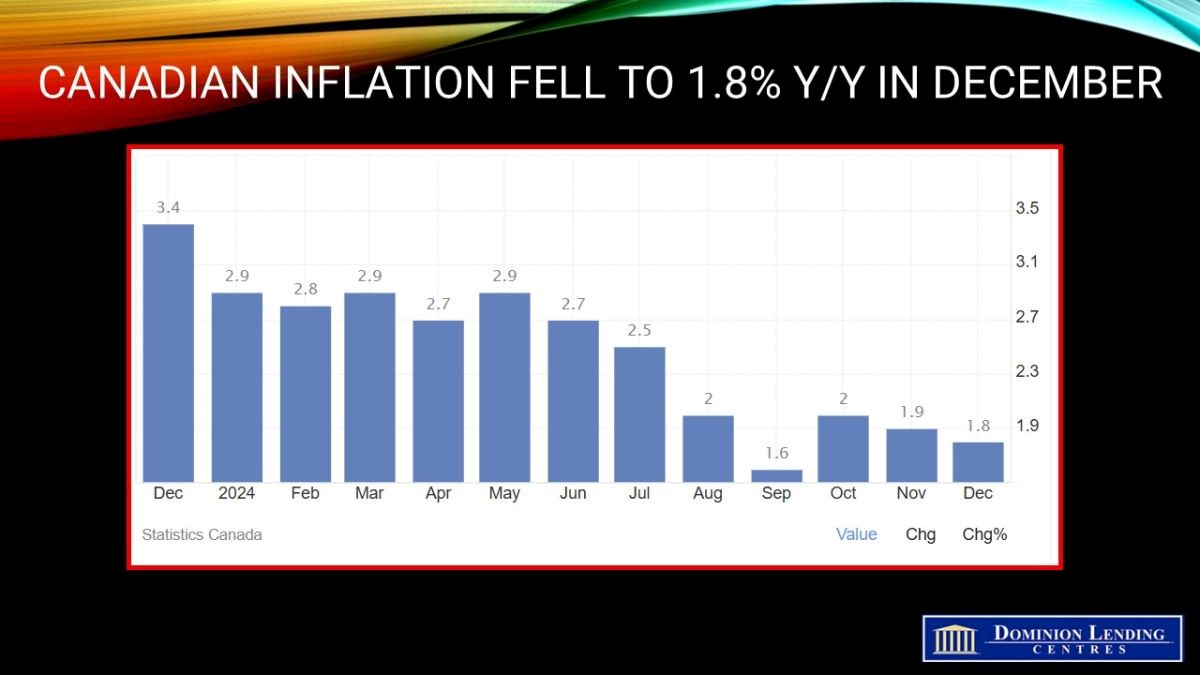
Canadian Inflation Falls to 1.8% y/y in December.
Positive News On The Inflation Front
The Consumer Price Index (CPI) increased by 1.8% year-over-year in December, a slight decrease from the 1.9% rise in November. The main contributors to this slowdown were food purchased from restaurants and alcoholic beverages bought from stores. Excluding food, the CPI rose by 2.1% in December.
On December 14, 2024, a temporary GST/HST exemption on certain goods was introduced. The major categories affected by this tax break included food; alcoholic beverages, tobacco products, and recreational cannabis; recreation, education, and reading materials; as well as clothing and footwear.
On a monthly basis, the CPI dropped by 0.4% in December after remaining flat in November. However, on a seasonally adjusted basis, the CPI increased by 0.2%.
Prices decline for items impacted by the GST/HST break
Approximately 10% of the all-items Consumer Price Index (CPI) basket is affected by the tax exemption.
In December, Canadians paid less for food purchased from restaurants, experiencing a year-over-year decline of 1.6%. This marked the index’s first annual decrease and the largest monthly decline of 4.5%, attributed to the GST/HST break.
On a year-over-year basis, prices for alcoholic beverages purchased from stores fell by 1.3% in December, compared to a 1.9% increase in November. Monthly prices also dropped by 4.1%, nearly tripling the previous largest monthly decline for this series, which was recorded in December 2005 at 1.4%.
The prices for toys, games (excluding video games), and hobby supplies decreased by 7.2% year-over-year in December 2024, a significant drop from the 0.6% decline in November. Additionally, the index for children’s clothing fell by 10.6% in December compared with the same month in 2023.
The shelter component of the CPI grew at a slightly slower pace in December, rising by 4.5% year-over-year, following a 4.6% increase in November. Rent prices decelerated on a year-over-year basis in December, rising by 7.1% compared to a 7.7% increase in November. Since December 2021, rent prices have increased by 22.1%.
The mortgage interest cost index continued to slow for the 16th consecutive month, reaching an 11.7% increase year-over-year in December 2024, the smallest rise since October 2022, which was at 11.4%, as interest rates continued to climb. Additionally, gasoline prices rose due to base-year effects, and consumers paid more for travel services.
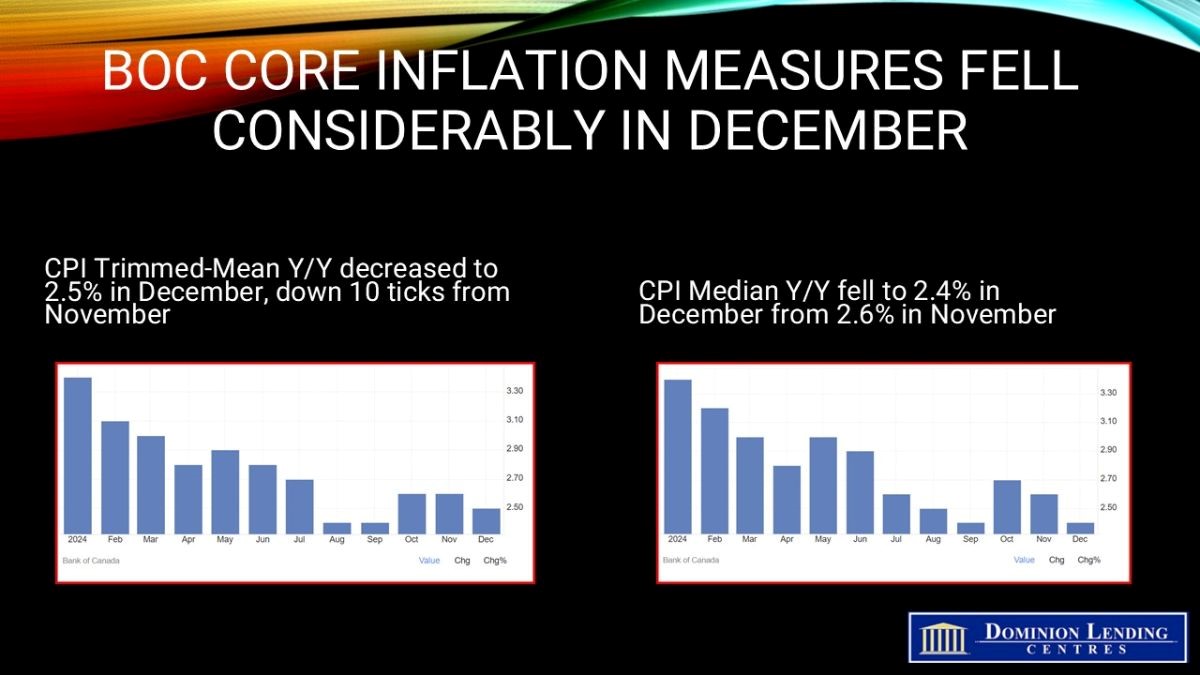
The central bank’s two preferred core inflation measures stabilized, averaging 2.65% year over year in October and November. Both core inflation measures rose a solid 0.3% m/m in seasonally adjusted terms and have been up at a 3+% pace over the past three months. Excluding food and energy, the ‘old’ core measure dipped to 1.9% year over year, its first move below 2% in more than three years.
The central bank’s two preferred core inflation measures declined, averaging 2.55% y/y in December. Both core inflation measures dipped m/m in seasonally adjusted terms and are up at a 3+% pace over the past three months.
Bottom Line
The inflation report for December 2024 showed a downward distortion due to the sales tax holiday, which will also affect the data for January. However, this effect will reverse in the following months. Core inflation measures are concerning, as the three-month moving average of trimmed-mean and median inflation has risen above 3.0%.
This inflation report is sufficient for the Bank of Canada to cut the overnight rate by 25 basis points to 3.0% on January 29, the date of its next decision.
A significant question remains regarding the potential Trump tariffs, which have been postponed to allow federal agencies time to analyze the trade, border, and currency policies of China, Canada, and Mexico. Trump mentioned yesterday that a 25% tariff would be implemented by February 1. However, government agencies typically do not move that quickly. Moreover, Trump aims to maintain pressure on these countries to ensure a robust response on border control and to reduce China’s influence on manufacturing in Mexico and Canada. The new administration also wishes to prevent Mexico and Canada from selling strategically important products to China.
I believe Trump wants to renegotiate the free trade deal between the US, Canada, and Mexico. Canada has already pledged to tighten its borders and has rejected Trump’s claim that it is exporting fentanyl to the US. I do not expect 25% tariffs on Canada; even if they are imposed, there would likely be Canadian retaliation, making the tariffs short-lived. This is a significant threat. Some have suggested that tariffs would compel the Bank of Canada to increase interest rates in order to combat inflation. While inflation might initially rise due to tariffs, the long-term effects would likely include layoffs and a marked slowdown in business and consumer spending, leading to increased unemployment. The Bank of Canada’s primary concern would be recession, not inflation.